Category: Blog

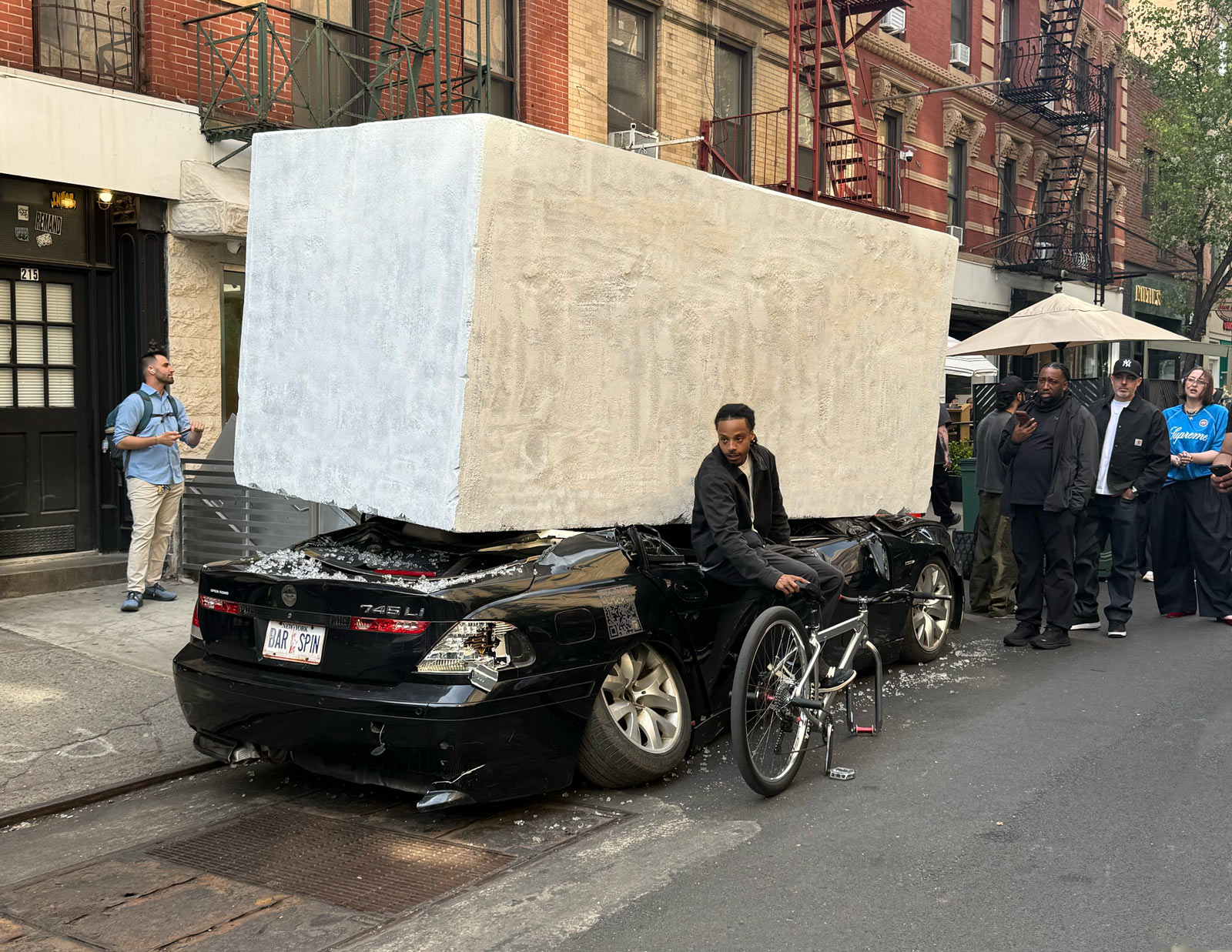
  • The car-sized concrete block that fell on the BMW in the middle of a street in Tribeca on Thursday didn’t delight me.

    The car-sized concrete block that fell on the BMW in the middle of a street in Tribeca on Thursday didn’t delight me.

    So I’ve been in New York.

    (First time here? Take a look at First Post to find out why I’m writing a blog.)

    On Thursday I did some gallery strolling in Tribeca and saw some beautiful artworks. At some point I felt faint and weird. I hadn’t eaten anything. Next door to the gallery where I was trying not to hit the floor was a Blue Bottle. For a moment I remembered something my friend Alex said about the Blue Bottle in Cambridge: “You pay them $6 and they put a drop of coffee on your tongue.” Funny how things like that can find a corner of your brain to settle in. I’ve never been to Blue Bottle, never even to the one in Cambridge. And here I was, slightly resistant because of what Alex said so many years ago about the portion sizes and prices.

    I was going to faint, so I went in.

    Gripping the counter, I ordered a cortado and a bacon and egg sandwich. (Just kidding about gripping the counter, I acted very normal.)

    As I waited at a standing counter, I noticed a woman next to me who looked like Laurie Anderson. She had the hair, the stature, and the coolness. It made me think of my favorite song by her called “Babydoll,” which always gives me delight to listen to. You should play it after you’re finished reading this, this whole post that I’m very thoughtfully writing.

    Fake Laurie Anderson walked away and I was left thinking about delight.

    Delight is one of those words we throw around in creative work all the time, but for some reason, on Thursday, as I scratched down some notes about this thought — and even right now — I can’t immediately list many creative things that gave me delight. And maybe that’s the magic of it?

    You don’t notice well-made delight when it crosses your path.

    • Antidepressants that are yellow
    • The weighty vacuum-y feeling an Apple product box has as you open it to reveal a new phone
    • A new elevator in Harvard Chan’s main building that says “lobby” with a sensual voice in such a way that it causes just a bit of discomfort, but is actually kind of delightful too?

    Someone, or a team, was behind those things. Those choices: the color of the pills, the exactness of the packaging fit, the sexy elevator announcement.

    By now I’m sitting at a window eating the sandwich which was mid, and drinking the cortado which was fine. Two women sat next to me looking down at Walker Street where passers by were being offered knock-off bags and wallets. They weren’t just looking, they were watching each transaction, or each almost transaction. Like sport. It wasn’t a huge variety of bags being offered and they seemed to know all of them by the point I began listening in.

    “There’s the Prada Noué again.”

    “Oh she’s looking at the Coach,”

    “That’s a nice one,” the other would say back.

    I finished a bite and turned to the woman closest to me, “These are knock-offs, right?” They both laughed and said yes. I knew that answer. They resumed watching the interactions on the sidewalk. A moment later I asked how much they go for. The woman said you were expected to haggle, and you shouldn’t spend more than $50 on any of them. They were very much knock-offs, after all. She said you need to look out for quality, like making sure the leather dye goes all the way through. They were good keepsakes, we both agreed. I gathered that this was a routine for these women, that they come and sit here at this window, drink their coffees, and watch the business of fake bags down below.

    It gives them … delight.

    And it’s free, but not cheap or fake, like the bags. Delight is valuable, even when it costs nothing. And that’s why it’s a powerful creative device. But it’s also easy to get wrong, or maybe half-wrong, because delight isn’t universal.
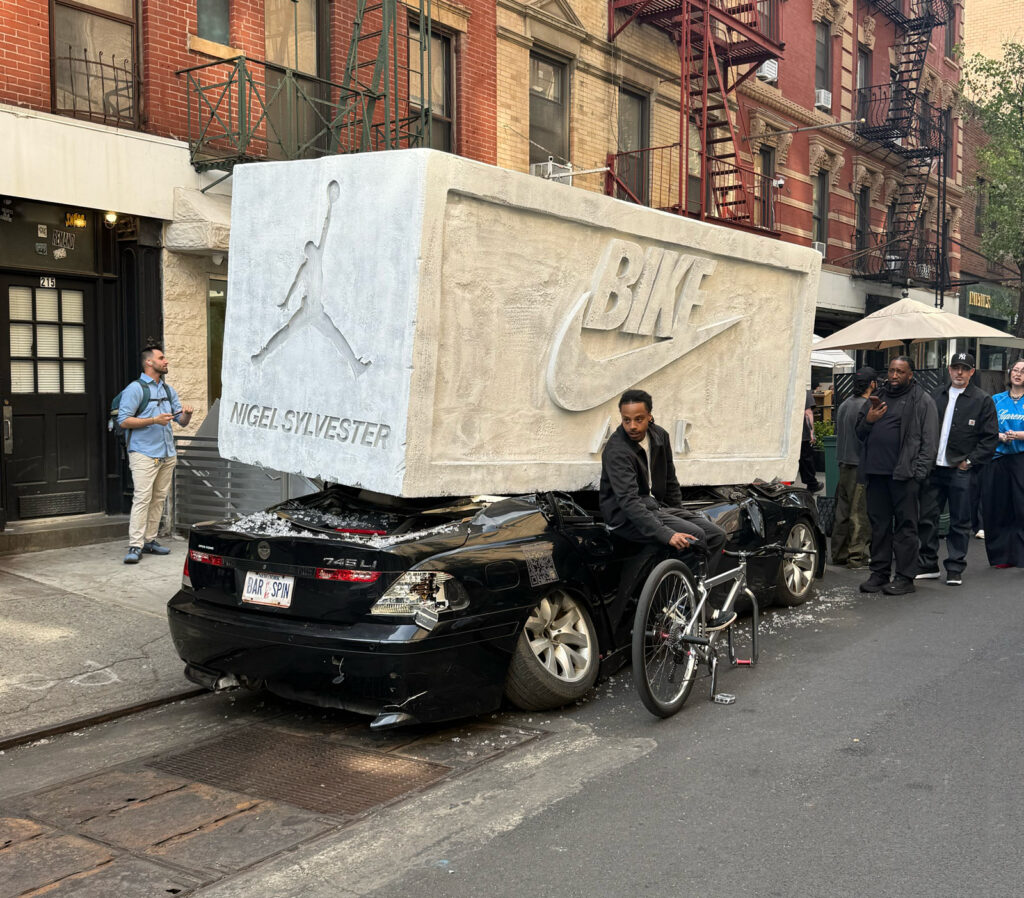
    After I left I walked toward another gallery and came upon a crowd. Getting closer, I saw a BMW with a giant concrete block appearing to have just crushed it. It’s part of a campaign collaboration between Nigel Sylvester and Nike and the artist FRIDGE. There was a buzz, people taking pictures, walking around it, standing in front of it. But I kind of … carried on? I knew the Nike and Air Jordan logo, but I didn’t know who Nigel was. What’s a “Bar Spin,” I thought? I wasn’t delighted, but so many others were.

    It wasn’t for me. Nigel Sylvester, I now know, is a BMX athlete. But I would also assume it wasn’t for many of the Nike execs (also not BMX athletes or fans) who had to greenlight it.

    Still, they understood the audience and the need to find a right and natural way to appeal to them.

    As I thought about this beyond my initial “nope” reaction to it, I empathized with the excited onlookers. It actually is really cool. Even if in the end it’s about selling a product.

    I’m reminded of something the creative director Jessica Walsh once said: “If no one hates it, no one really loves it.” Making good work that delights comes with the understanding that you really need to know who you’re selling it to, and accept that it’s not everyone.

    Delight.

    It’s best when it’s natural, accidental, like the ladies watching the bags be sold. If created, it works when it feels discovered, not delivered, and when it tickles something inside you.

    “Hey bestie,” as a greeting at the start of a vitamin company’s email reminding you to update your payment method? Fuck that, get that out of here, that doesn’t delight anyone.
  • “Mural as a mirror”

    “Mural as a mirror”

    Woah, I’m back so soon.

    This blog is about getting to the heart of creative work (read more about that here), and yesterday, while sitting in what might sound like a boring Harvard committee meeting, I was struck by a whole lot of creative heart, happening in real time.

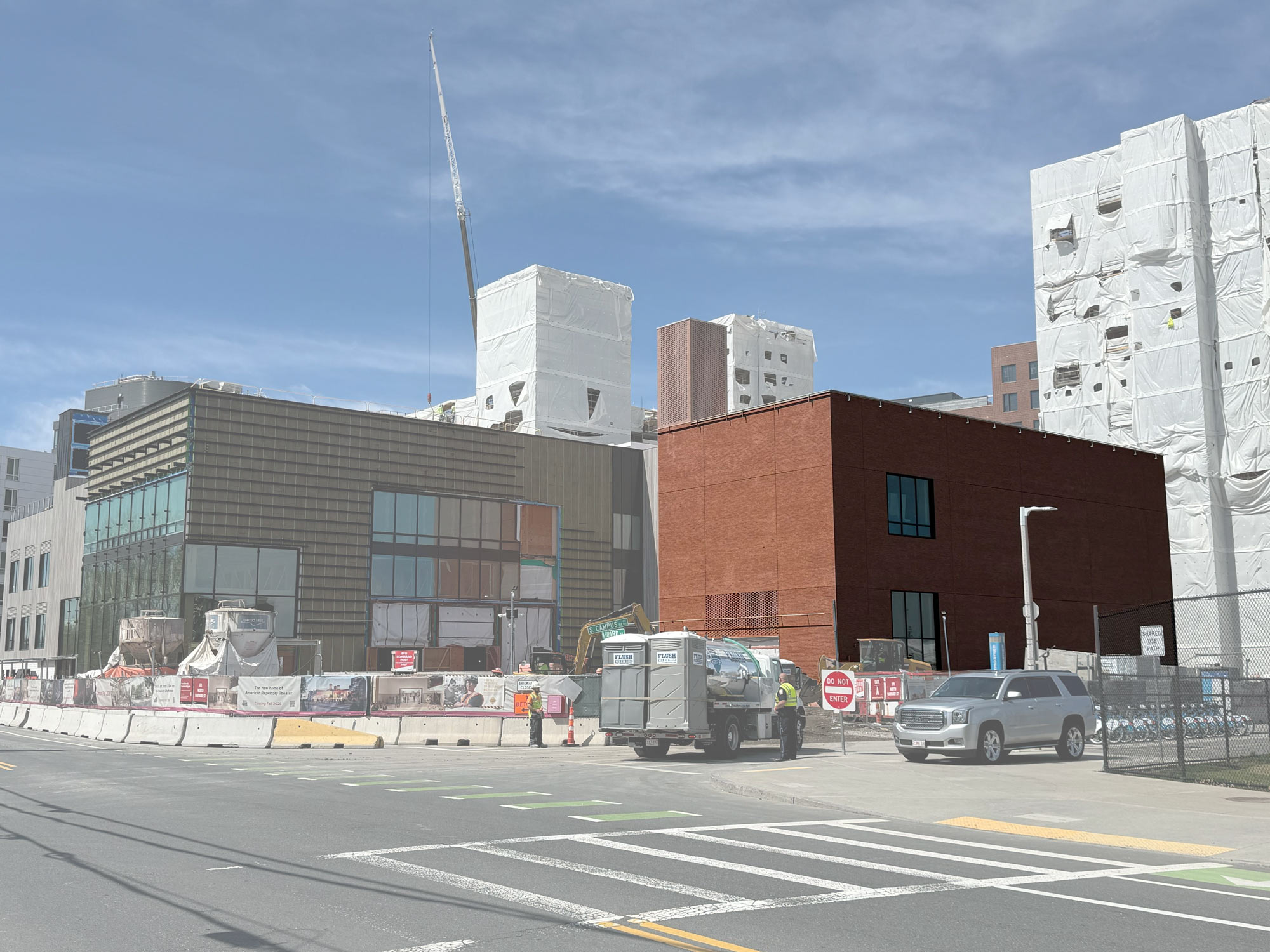
    Harvard’s American Repertory Theatre is constructing a new home in Allston Village, and as part of the project, they’ve commissioned a mural from one of the city’s favorite muralists, Rob “Problak” Gibbs. Rob spoke about the project, the process, and his creative inspiration to the university’s public art advisory committee, of which I am part.

    During the meeting, it occurred to me that I hadn’t thought very much about murals, beyond respecting them as an art form and how they can add to a city’s vibe and humanity. Rob was right on top of that with his vision, and the resulting semi-final design he showed us (which you will have to just imagine since I can’t share the pic here…) captured a deep and powerful concept: Stories are carried through time by the collective.

    The mural was grounded in this idea that we’re all connected through time and shared experience. And the style felt like the true essence of Allston-Brighton — not the sterile, cut-and-paste take on placemaking we see across the city.

    That sense of grounding — being connected to the local (and human) experience — isn’t the only part of this A.R.T. project that feels like that. At one point, Dayron Miles, the organization’s associate artistic director, excitedly shared some of the thinking behind the building design itself. He said, maybe hyperbolically, maybe not, that they redesigned the building during the early days of the pandemic ~20 times. They were trying to get at something, and the word he used was “crafted.” They made material choices they wanted to feel worn, to age organically, or even materials that have already aged, like the reclaimed brick from Harvard Square’s iconic “pit,” a historic gathering place in the center of the square.

    He said he wanted the building to “feel like paper.”

    I understand what he meant. He wanted it to feel familiar, maybe not like home, but something close to that. When he talked this way, I could smell this building, feel its air, and see the light casting through its windows.

    Murals aren’t meant for visitors, even though one of their common tasks is brightening anyone’s day. A mural is really meant for the community it belongs to, for the people who will see it hundreds, maybe thousands of times. They become like the familiar faces we see on our commutes, running errands, or visiting a public park. Over time we come to know them.

    And the best ones we eventually realize, know us.

    Rob said “mural as a mirror” early in the presentation, and I couldn’t put it better.

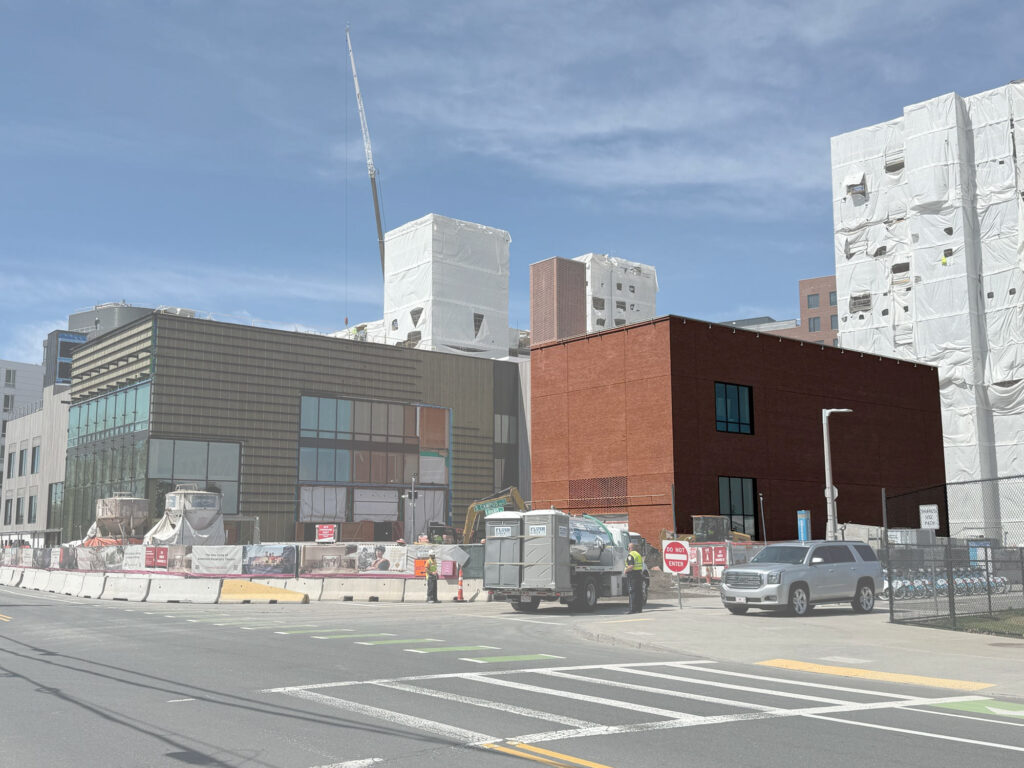
    New A.R.T. location in progress. Future location of the mural emphasized.

  • First post

    First post

    I never had a blog before.

    Well, that’s a lie. Once in college I had one of those “this is such a good idea and will make me successful” ideas of creating a blog called “The Y Beat.” It was going to be centered on marketing ethics, a topic I was interested in at the time, and other thought pieces from a (my) millennial lens. That “voice of a generation” ego many of us early 20s dreamers leaned toward at the time, which Lena Dunham did so well.

    But in actuality I forgot I even started the blog shortly after writing and posting a few essays, and all of its potential slowly vanished from my mind. Onto the next thing it was.

    To be honest, I feel kind of silly here.

    Professionally, I write and edit all the time. Catchy copy, blurbs, boring stuff like policy documents or training materials … but writing from my voice, Ben’s real feelings, online … where people can find it, on a portfolio site, where potential clients or employers can see it? No, no, that’s for the journal I keep to myself. But here I am, laying down words with just a little bit of editing, for anyone to find.

    I think I had a blog before the one I came up with in college too, actually. Like most people born when I was, in that age range where we experienced the formation of the internet at the same time our bodies were developing (puberty, I’m referring to puberty), I had a primordial social media profile that I had to build myself: a GeoCities website. That’s a blog, right? The content of this website is lost to the ages, but I do remember the very, very, important and rewarding task of selecting the section dividers.

    Somewhere along the way I think the wonder left my eyes.

    Just kidding. Let’s talk about what this is, this blog. This won’t be about my personal life, I mentioned the journal I keep to myself earlier, that’s where all that goes. I’ve been journaling for most of my life and I think I’ve found a way of flowing my thoughts onto paper that feels natural, is very me, and doesn’t always sound bad. Some of it’s actually good. Profound, even! But that kind of writing is personal, like about heartbreak and stuff.

    You know what else is personal though? Creative work.

    That’s the lane here. Maybe no one will ever read it, and if not, I’d say they’re missing out because I’m going to get personal about design and creativity and sometimes it might even be profound.

    They say (who’s they? I dunno) one of the earliest and most important milestones a creative person reaches is learning to not take their work too personally. But that’s too simple, I think. If we don’t take the work personally, where’s the heart in it? How do we put heart in our work, but not our own hearts?

    Empathy.

    Empathy makes creative work great. And it’s useful from the most mundane piece right on up to the fundraising video that makes its viewer laugh, cry, then laugh again. Or just cry, like Sarah McLachlan’s ASPCA commercials — someone adopt those animals, please!

    Yo I feel like Carrie Bradshaw kinda.

    So I’m gonna get started writing. I think I’ll do some “pull it from the archives and talk about it” type posts and also cover some current work and musings about what’s going on professionally and in the world (oof) right now. I, a) hope someone reads this — just one person would be wild! — and b) hope I don’t forget about it like I did with “The Y Beat.”

    *Walks away mid-thought.*
